

Choosing a Legal Structure in Costa Rica | Foreign Investors
If you’re investing in Costa Rica, one of your first decisions is how to hold your assets or operate your business. The right legal structure depends on your goals — whether you’re forming a company, expanding an existing business, or buying real estate — and choosing well at the start is far easier than restructuring later.
This guide walks through the most common options for foreign investors in Costa Rica and how to think about which one fits.
Company Structures in Costa Rica
Sociedad Anónima (S.A.)
A flexible corporation commonly used for businesses and investments, particularly where there are multiple owners or you anticipate bringing in future investors. It offers a formal governance framework and limited liability.
Sociedad de Responsabilidad Limitada (S.R.L.)
A simpler structure, often preferred for small businesses and closely held companies. It carries lighter administrative requirements than an S.A., which is why many owner-operators choose it.
Branch Office
Allows an existing foreign company to operate in Costa Rica without forming a separate corporation. Useful when you want your Costa Rican activity to sit under the parent company.
Representative Office
Suitable for market research or business development, but not for commercial operations. A common misstep is setting one up and then discovering it can’t do what you need.
EIRL
A limited liability structure designed for a single business owner — the simplest option when there’s only one principal and no plan to add partners.
S.A. or S.R.L.: Which Do Foreign Investors Choose?
Both provide limited liability, so the practical difference is governance and upkeep. An S.A. suits multiple shareholders, outside investment, or a more formal corporate structure. An S.R.L. is generally simpler to administer and fits closely held ventures.
Either way, a Costa Rican company brings ongoing obligations — accounting, tax filings, corporate maintenance, and annual compliance — so the structure should be worth the upkeep it creates.
Is a Company Always the Best Option?
Not necessarily — and this is where many foreign buyers go wrong.
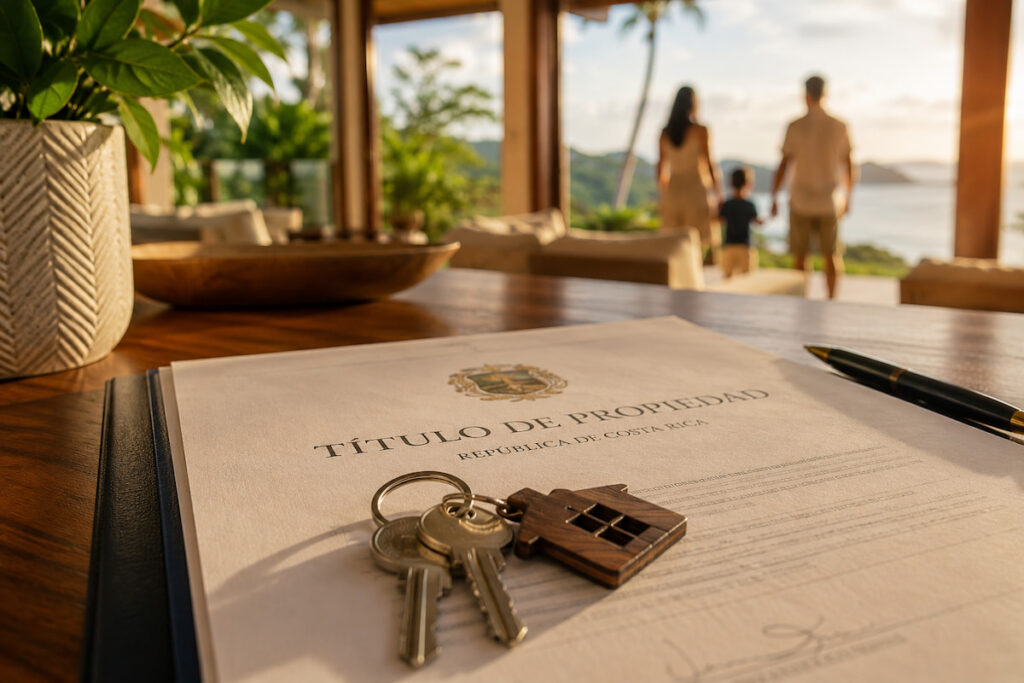
Many assume they need to purchase Costa Rican real estate through a corporation. That can be appropriate in some cases, but it isn’t always the most effective or secure approach. If your primary goal is to own real estate rather than operate a business, a company may be more administrative burden than benefit.
For those clients, a fiduciary trust (fideicomiso) often fits better. A properly structured trust can provide privacy, simplify succession planning, protect assets, and allow ownership without holding title in your personal name — which matters more than most buyers realize, because Costa Rican inheritance rules and probate timelines differ significantly from those in Canada and the United States.
If you’re buying property rather than starting a business, see our guide on [Due Diligence for your Property Purchases in Costa Rica].
How to Choose
The right structure depends on your objectives, estate planning needs, and long-term investment strategy. In practice, the questions worth answering first are:
- Are you operating a business, or holding an asset?
- Will there be partners, employees, or outside investors?
- How do you want the asset to pass to your family?
- How much ongoing administration are you willing to maintain?
We’re Here to Help
At Guanacaste Legal, we help foreign clients determine the most appropriate legal structure before they invest. Through our affiliate, Costa Rica Fiduciary Trust, we also offer fiduciary trust solutions for clients seeking a secure and efficient way to hold real estate in Costa Rica.
Choosing the right structure from the beginning can protect your investment for years to come.
Not sure which structure fits your situation? Every investor’s goals are different. We offer a complimentary consultation to walk through your options — company, trust, or direct ownership — with no obligation. [Book your complimentary consultation here]